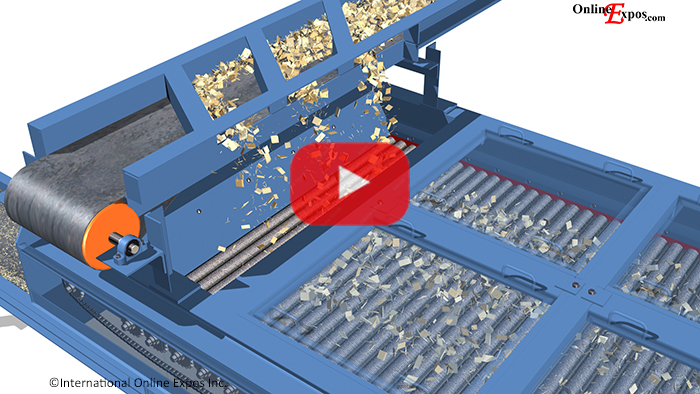
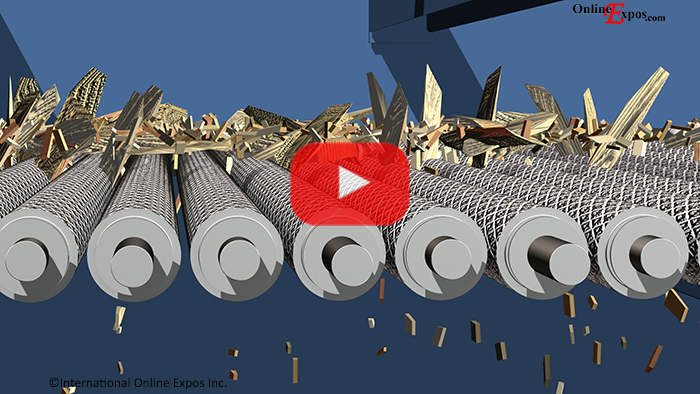
Select below to view video or information on chippers & chip screens. See how these chippers and screens process chips, including oversize and fines. Compare chipper and screen types.
Roll screens allow the separation of chip fines with a controlled thickness. Acceptable chips are carried over the top of the rolls and the fines (thin) chips are discharged below.
Roll screens allow the separation of thick chips with a controlled thickness. Acceptable chips (thickness) are discharged below and over thick chips are carried over the top of the rolls.
Functional Description
Chippers:
Used to process trees, stems, logs or blocks into wood chips for making pulp and paper.
A chipper consists of a housing containing a rotating disc. Chipping knives, counter knives and clamps are mounted to the chipper disc. As fibre is fed into the chipper it is chipped to the length determined by the setting of the distance of the chipper knife to the chipper disc face plate.
There are several types of chippers. Disc chipper, slant disc chipper and drum chippers are the most common type. Drum chippers are primarily used for trim blocks while disc chippers are used for whole log chipping and chipping of longer materials including whole log chipping and edger tailings. Chippers can be horizontal feed or drop feed.
Chip Screens:
Used to classify chips, sawdust, “flakes” and other wood products into various sizes to meet market requirements.
Rotary, or shaker, chip screens have decks of screens with different size openings in each deck to screen out overs, accepts and fines. The top screen would typically have 50 mm (2″) to 60 mm (2-1/2″) openings. Chip material larger than this would cascade over the screen and be directed to rechipping. The bottom screen would have openings that represent the fines classification. These openings would typically be 6 mm (1/4″) to 10 mm (3/8″). Chip material that drops through the top screen and is retained on the bottom screen is acceptable chip material (accepts). Chips and sawdust that falls through the bottom screen is classified as fines.
Thickness chip or particleboard screens are designed to specifically screen out over thick chips. A typical thickness screen would consist of a series of rolls with spaces between them set to represent maximum chip thickness. As the chip material passes over the rolls, any material that is thinner than the opening between the rolls would fall through as acceptable chips. The over thick chips would cascade over the rolls for further processing.
Industries Served by Online Expos/Solid Wood/Chippers & Chip Screens:
The Chippers & Chip Screens section of Online Expos serves the solid wood sector (sawmills, planermills, remanufacturing, pulp mills).
Types of Wood Products Equipment and Resources Available to View on Online Expos: