
Home » Sawmills & Planermills » Lumber Trim & Sort
Select below to view video or information on lumber handling, trimming and sorting. See how these lumber sorters and materials handling equipment improve productivity. Compare types of lumber sorting equipment.
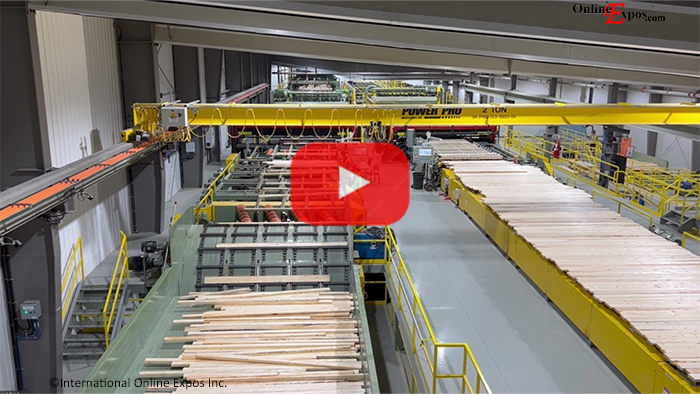
Select below to view video or information on lumber handling, trimming and sorting. See how these lumber sorters and materials handling equipment improve productivity. Compare types of lumber sorting equipment.
.
Lumber trimmers are high-speed material handling and processing systems used in sawmills and planer mills to cut boards to precise lengths while removing defects, damaged ends, or non-conforming sections. Positioned downstream of primary breakdown equipment or planers, trimmers ensure lumber products meet dimensional and quality specifications before sorting and packaging.
Modern lumber trimmers typically consist of an infeed conveyor, board positioning system, scanning equipment, and multiple high-speed saw stations. Advanced systems utilize laser measurement, machine vision, and optimization software to determine the most valuable cutting solution for each piece of lumber. Based on species, grade, defect locations, and customer requirements, the optimizer selects the optimal trim points to maximize product recovery and value.
High-production trimmers can process hundreds of boards per minute while maintaining tight length tolerances. Common applications include dimensional lumber production, appearance-grade lumber processing, remanufacturing operations, and engineered wood product manufacturing. Automated trimmers improve recovery rates, reduce waste, increase throughput, and provide consistent product quality throughout the production process.
Lumber sorters are automated material handling systems designed to classify, accumulate, and organize lumber according to predetermined criteria such as dimensions, grade, species, moisture content, destination, or customer order requirements. Sorters serve as a critical link between lumber processing equipment and downstream packaging, drying, remanufacturing, or shipping operations.
A typical lumber sorting system consists of transfer conveyors, lug chains, scanning equipment, sorting bins, and automated controls. As boards enter the system, sensors and scanners collect information regarding size, grade, moisture content, and other product characteristics. Control software then directs each piece to a designated sorting bin or storage location.
Modern lumber sorters may incorporate machine vision systems, barcode tracking, RFID technology, and mill-wide production management software to provide real-time inventory control and production monitoring. High-capacity installations can manage dozens or even hundreds of sorting pockets while processing thousands of pieces per hour.
By automatically organizing lumber into specific product categories, sorters improve production efficiency, reduce manual handling, increase packaging accuracy, and support just-in-time manufacturing and shipment requirements. Lumber sorting systems are widely used in sawmills, planer mills, remanufacturing facilities, and engineered wood product plants.
The Lumber Trim & Sort section of Online Expos serves the solid wood sector (sawmills, planermills, remanufacturing).
Sawmills & Planermills | Board Edgers | Canters, Bandmills & Sawboxes | Chippers & Chip Screens | Debarkers, Hogs & Flare Reducers | Dry Kilns & Lumber Drying | Energy Systems | Gang Edgers | Log Merchandisers & Log Handling | Lumber Stackers | Lumber Trim & Sort | Optimization & Controls | Planers & Molders
Mass Timber | Beam Planers | CLT Presses | Finger Joint Machines | GLT Presses | Grade & Sort
Calculators, Tools & Technology | Dust Collecting | Mass Timber | Saws & Knives | Wood Characteristics