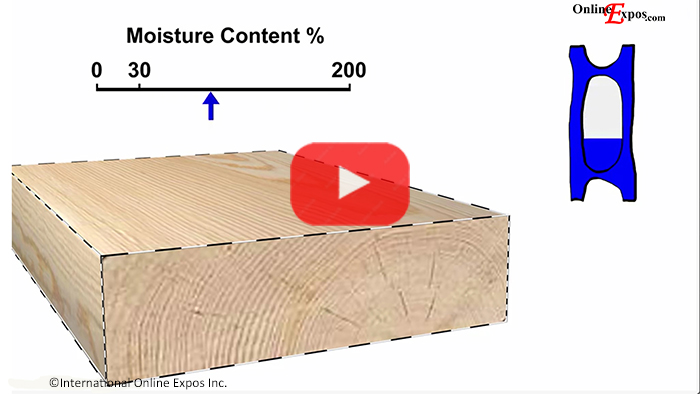
Free water is held within the cell cavity. Bound water is held within the cell walls. The fiber saturation point is the moisture content at which moisture is saturated within the cell walls of wood and the cell cavities are free of water. This is normally at ~30% moisture content. Lumber shrinkage starts when lumber is dried lower than the fiber saturation point.
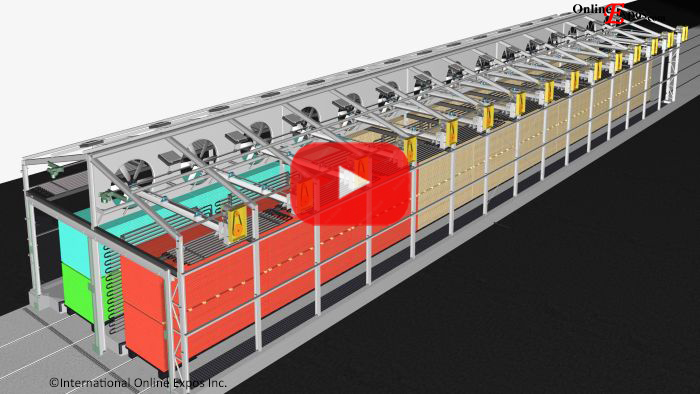
The Counter-Flow Dry Kiln delivers continuous non-stop production. Lumber stacks run in opposite directions allowing heat coming off the dry lumber to preheat the green lumber packs.
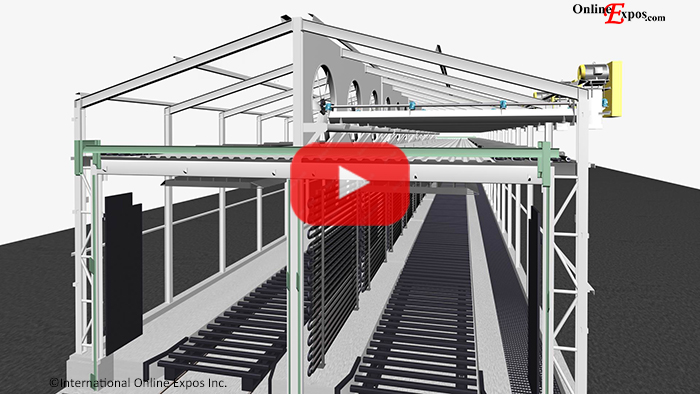
Loaded from one end or both ends. Horizontal overhead and vertical center reheat coils. Zoned from side to side and along the length for uniform heat control. The fans can be fixed or variable pitch.
A typical dry kiln is constructed of steel, aluminum or a combination of both. The panels are grade 1100 aluminum skins with Thermax or fiberglass insulation. There are I-beam monorail door carrier s which can be heated to prevent freezing.
Functional Description
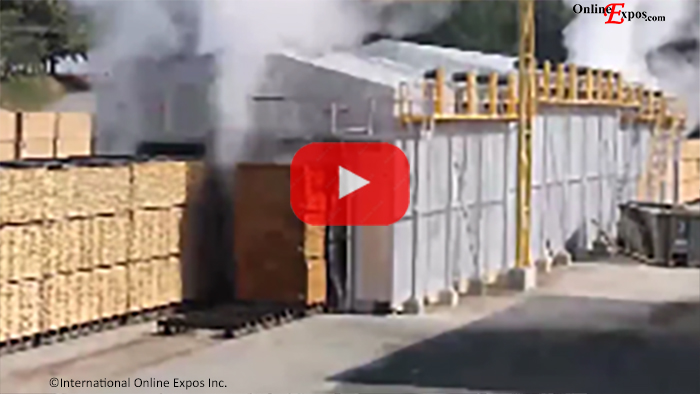
Lumber dry kilns are utilized to remove moisture from hardwood and softwood lumber and timber in a controlled environment. A lumber dry kiln consists of one or more chambers designed to provide and control the environmental conditions of heat, relative humidity, and air circulation necessary for the proper drying of wood. Dry kilns typically dry lumber to between 3 and 19 percent moisture content.
Dry kilns are usually either compartment type (track or side load) or progressive type. In a compartment type dry kiln stacked loads of stickered, or stripped, lumber are loaded into the kiln to be dried in a stationary batch process. In a progressive type dry kiln stacked loads of stickered, or stripped, lumber enter the green end of the kiln and are moved forward through the drying chamber until exiting the dry end of the kiln.
Heating medium for dry kilns can be direct fired heat (gas or wood fired combustion), thermal hot oil, steam or hot water. There also are dehumidification kilns as well as vacuum kilns. Vacuum dry kilns utilize RF (radio frequency) or steam to provide heat for drying and are primarily used for hardwoods and timbers.
Conventional compartment type lumber dry kilns are usually either single track or double track. The air flow in these kilns can be single air pass or double air pass. The fans on single air pass dry kilns force the air through the loads on one track. The fans on double air pass dry kilns force the air through the loads on both tracks. Top baffles, bottom baffles and door (end) baffles prevent air circulation from going around the loads of lumber to reduce checking or warp.
The control system for a dry kiln is divided into zones side to side and along the length for more accurate drying. Each zone’s heat and humidity are controlled by regulating the heat and roof vents. Venting occurs when the relative humidity is higher than the set point.
Industries Served by Online Expos/Solid Wood/Dry Kilns & Lumber Drying:
The Dry Kilns & Lumber Drying section of Online Expos serves the solid wood sector (sawmills, planermills, remanufacturing).
Types of Wood Products Equipment and Resources Available to View on Online Expos: