Seasoning removes moisture from lumber by air drying, kiln drying, or a combination of the two. Uneven drying stresses and differences in shrinkage can produce separations or changes in shape. Checks and splits are separations; bow, crook, cup, and twist are forms of warp and may occur together. Their significance depends on severity, piece dimensions, intended use, and the applicable grading rules.
Bow
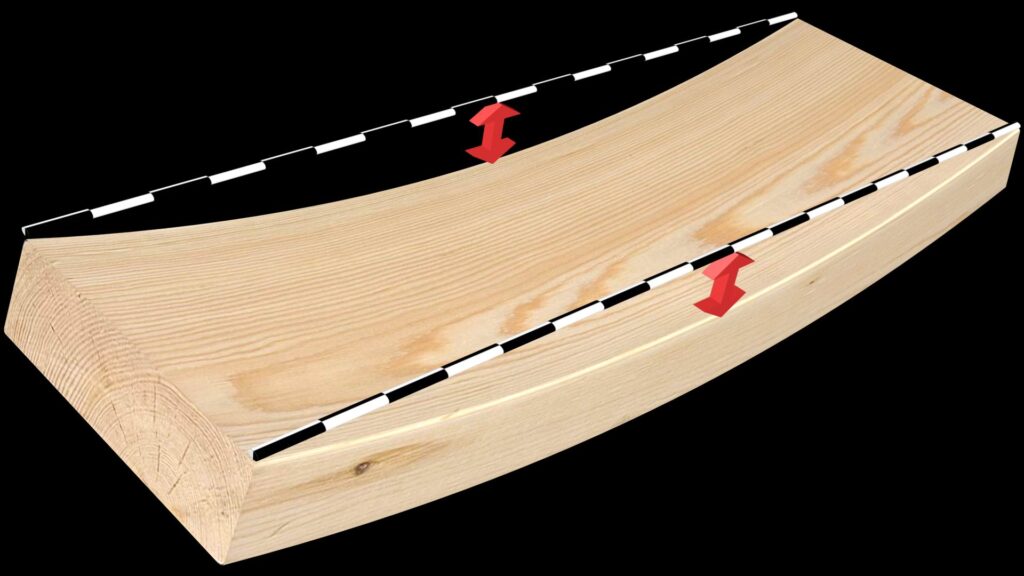
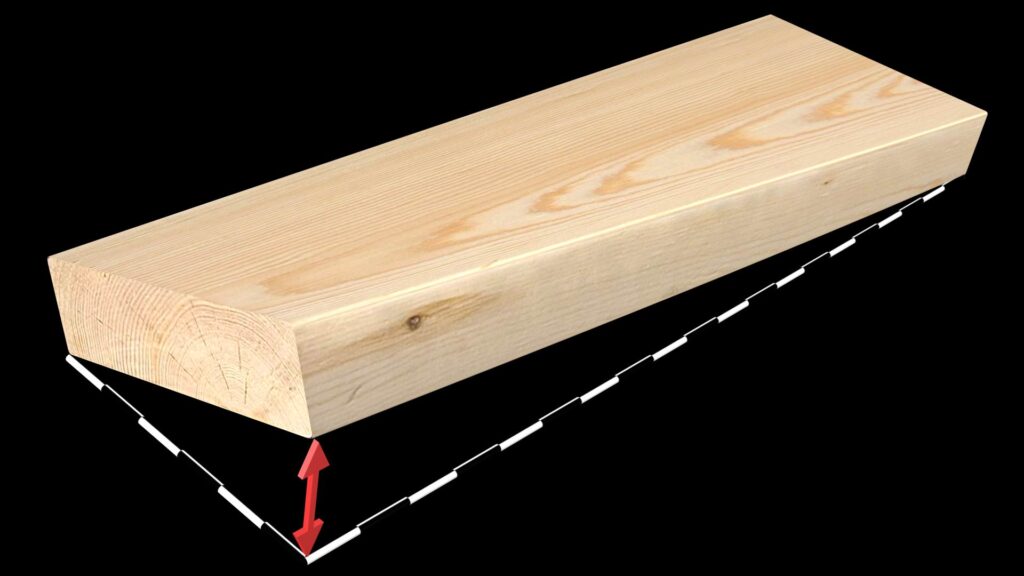
A form of warp in which a piece curves flatwise along its length, so that its wide face departs from a straight line joining the ends. It commonly develops from unequal shrinkage along the grain on opposite sides of the thickness; uneven support or restraint during drying can also contribute. Measure bow as the greatest perpendicular distance between the face and an end to end reference line. Bow can interfere with alignment, bearing, assembly, and machining to a uniform finished thickness.
Checks
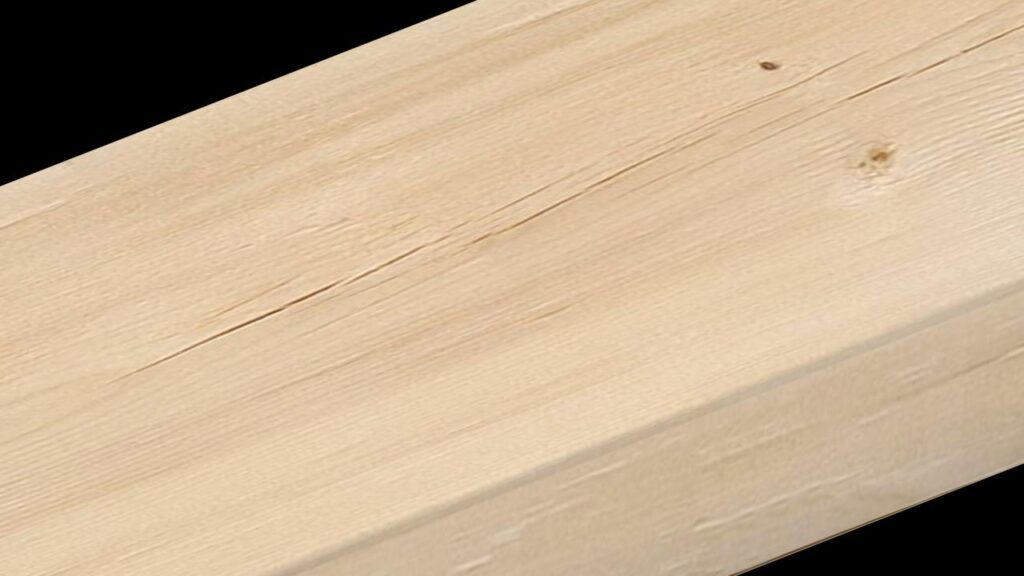
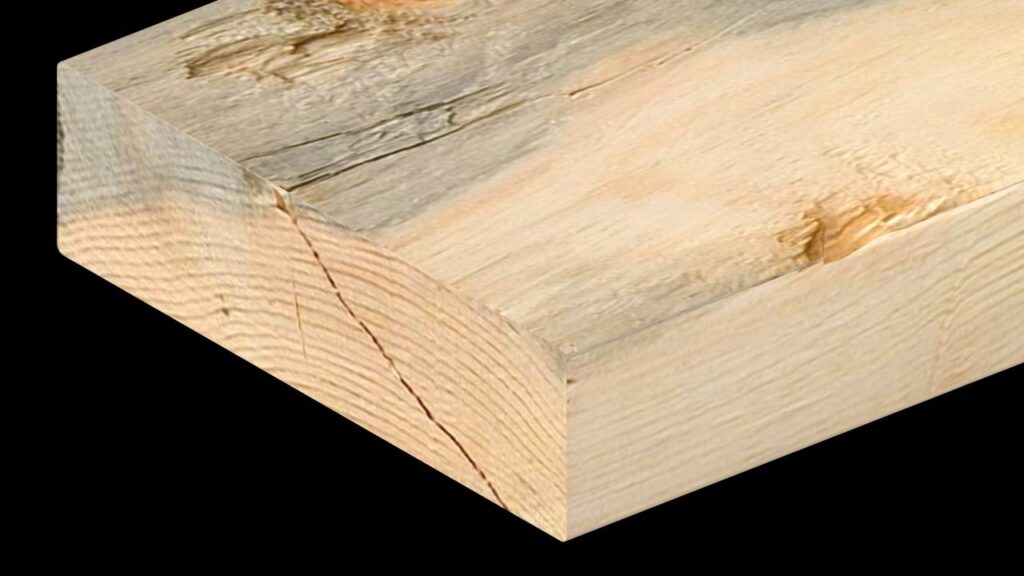
Separations of wood fibres that extend along the grain, generally across the growth rings, and commonly develop when exposed surfaces dry and attempt to shrink while the wetter interior restrains them. This restraint creates tensile stresses that can exceed the strength of the wood perpendicular to the grain. Checks may occur on faces or ends and vary in length, width, and depth; they are not necessarily small or shallow. They interrupt surface continuity and may reduce usable yield or affect performance, depending on their extent and position.
Crook
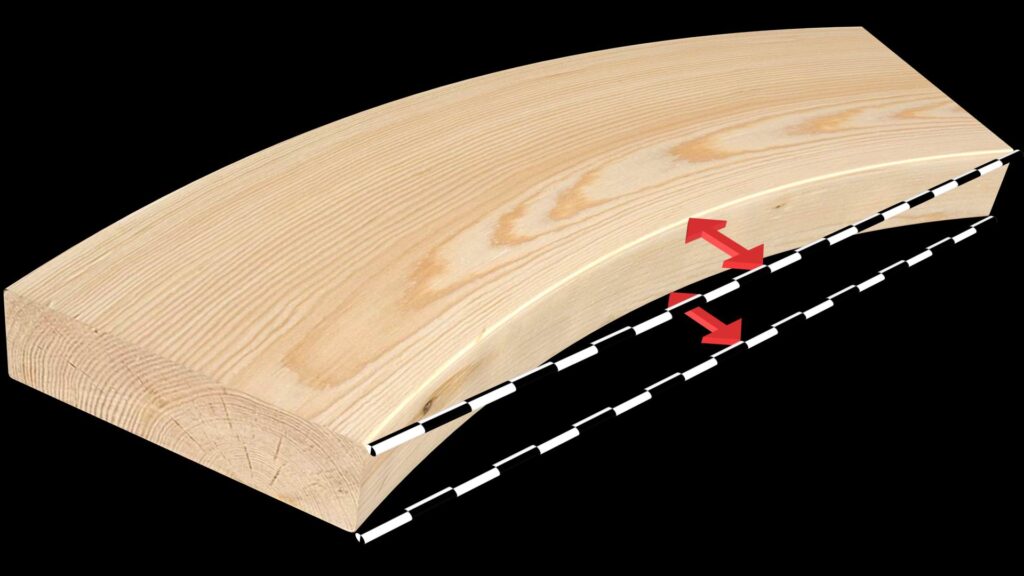
A form of warp in which a piece curves edgewise along its length, producing a sweep visible when looking at the wide face. It commonly results from unequal shrinkage along the grain across the width, which may be associated with reaction wood, juvenile wood, or irregular grain. Measure crook as the greatest perpendicular deviation of the affected edge from a straight line joining its ends. Crook reduces the straight length or width recoverable from a board and can complicate framing, edge joining, and further machining.
Cup
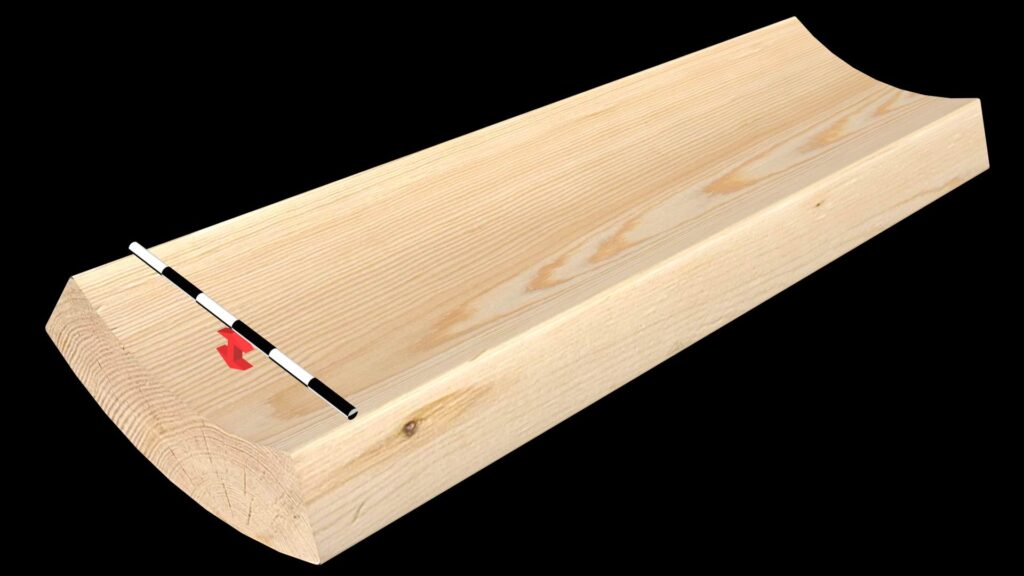
A form of warp in which the wide face curves across the width, creating a concave face and a corresponding convex face. It commonly develops because shrinkage tangential to the growth rings differs from shrinkage perpendicular to them, particularly in flatsawn lumber. A moisture difference between opposite faces can also contribute. Measure cup as the greatest gap between the concave face and a straightedge spanning from edge to edge. Cup affects flat contact, joint fit, and the thickness recoverable by flattening.
Splits
Separations along the grain that extend through a piece from one surface to an opposite or adjoining surface, often beginning at an end. Seasoning splits can develop when end checks deepen or drying stresses cause the wood to separate through the section. Similar openings can also result from mechanical damage, including forcing a cupped board flat during planing. Record split length and the surfaces connected by the opening. Splits can reduce continuity around fastenings and joints and may require trimming, subject to the applicable grading rules.
Twist
A form of warp in which the cross section rotates along the length, leaving the corners of a piece out of a common plane. It is often associated with spiral or diagonal grain and unequal shrinkage during drying; inadequate support or restraint can increase its expression. To assess twist, place both edges at one end against a flat reference surface and measure the rise of the lifted edge at the opposite end without forcing the piece flat. Twist impairs alignment and flat contact and can require substantial stock removal to correct.
Technical references
National Lumber Grades Authority. Standard Grading Rules for Canadian Lumber, 2025. Paragraphs 704, 742, and 752: checks, splits, and measurement of warp. View source
USDA Forest Service, Forest Products Laboratory. Air Drying of Lumber, FPL-GTR-117. Drying defects and forms of warp. View source