Project Based Mass Timber Demand Calculatorr:

This demand model focuses on project-based mass timber (buildings with CLT, CLT / GLT combined or MPP).  This would be the target products manufactured for a large scale CLT / GLT factory.  It does not include commodity GLT, DLT, NLT or rig mats.  The purpose is to project potential growth for determining opportunity for added factories.  For calculating the economics of a large scale $140+ million factory it is important to understand the market segment.  The inclusion of all of mass timber sectors in the market analysis could be misleading.

  • Estimating the future demand for mass timber is somewhat subjective.  The famous aphorism “All models are wrong, but some are useful” was coined by the British statistician George E. P. Box.  For a model to have a useful purpose it is critical that the input data is as accurate as possible.
  • The British Columbia (B.C.) mass timber ecosystem, from architecture through to construction, is at a higher level of maturity than most regions in North America.  B.C. mass timber adoption will form the basis for the calculation of estimated demand for mass timber in North America.  The current adoption ratio in B.C. is 4.5 m3/000 capita and is used as the Benchmark Adoption Ratio (BAR).  Coincidently, the B.C. adoption ratio is similar to Europe which has been utilizing mass timber for over 35 years.
  • Estimating future demand based on historical North American consumption is difficult as most mass timber buildings in North America have been iconic or institutional buildings.  Growth potential will not be realized until mass timber becomes mainstream in mid-rise multi family and office buildings.  A mass timber specific grade of input lumber will also be required for growth of mass timber consumption to reach the levels of Europe.
  • For this model, each province and state is individually evaluated for growth based on the current maturity level in the mass timber sector.  The 2024 mass timber consumption is based on the production volume, population, population growth and mass timber growth projections are based on Anthropic AI data.  Note that the stated consumption for 2024 balances to the output of the existing North American factories leaving a bit for European import volume.  The model allows users entry for current consumption estimates by province/state and the estimated year to reach the BAR.  The summary output is separated into regions across North America.
  • The scenario buttons toggle to conservative, base or progressive compound annual growth rates.  These rates are then converted to the year a province or state would reach the BAR.  These growth rates are subjective based on low-medium-high estimates from Anthropic.  The basis for progression is the state of the mass timber ecosystem.  Progressive CAGR is a scenario where codes are in place and mainstream midrise buildings are being constructed with mass timber.
  • Feedback on current consumption by province/state and estimates on the year a province/state would reach the BAR would help develop more accuracy in the model output.  It will be beneficial if those with accurate consumption data, and knowledgeable of mass timber progression for a province/state could provide this information.  Please email relevant consumption and mass timber ecosystem status to info@onlineexpos.com.  This information will be analyzed and utilized for updating the model.  We will be providing ongoing research as well for improvements to reliability of the model.

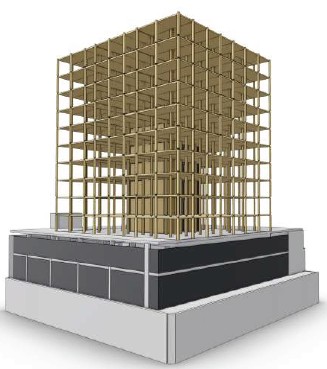
10 Over 2 Building

  • The ’10 over 2′ building is a concept socialized by Wesgroup Properties, Vancouver, British Columbia. It is a 10-story mass timber building over a 2-story concrete podium.  It is a multi family residential building with 10 suites per floor.
  • The concept would be a catalog of standard layouts to reduce costs and improve efficiencies from forest to completed building.

Mass Timber Demand in North America:

Mass timber demand in North America is developing as owners, designers, and builders explore lower-carbon materials and prefabricated construction methods. Housing, commercial, and institutional projects offer opportunities for broader adoption, supported by advances in engineered wood systems and growing design and construction experience.

  • Future demand will depend on how consistently mass timber can meet project requirements for cost, performance, construction schedules, and insurability.
  • Growth is likely to vary across provinces, states, and building sectors as local markets develop.
  • For manufacturers, the central planning challenge is translating interest and proposed projects into reliable annual consumption estimates.
  • Demand scenarios should therefore account for regional adoption rates and project timing when evaluating opportunities for additional production capacity.