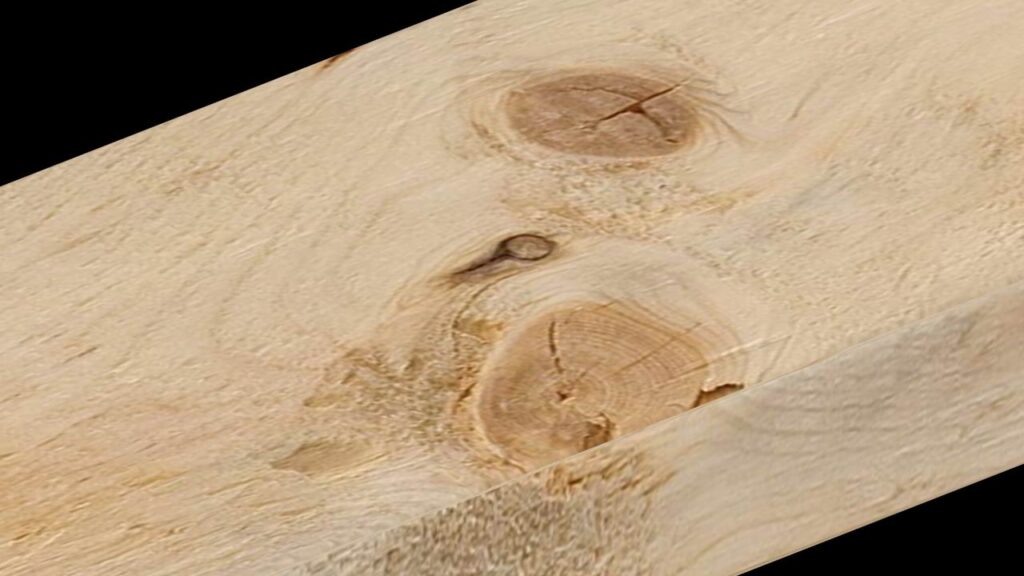
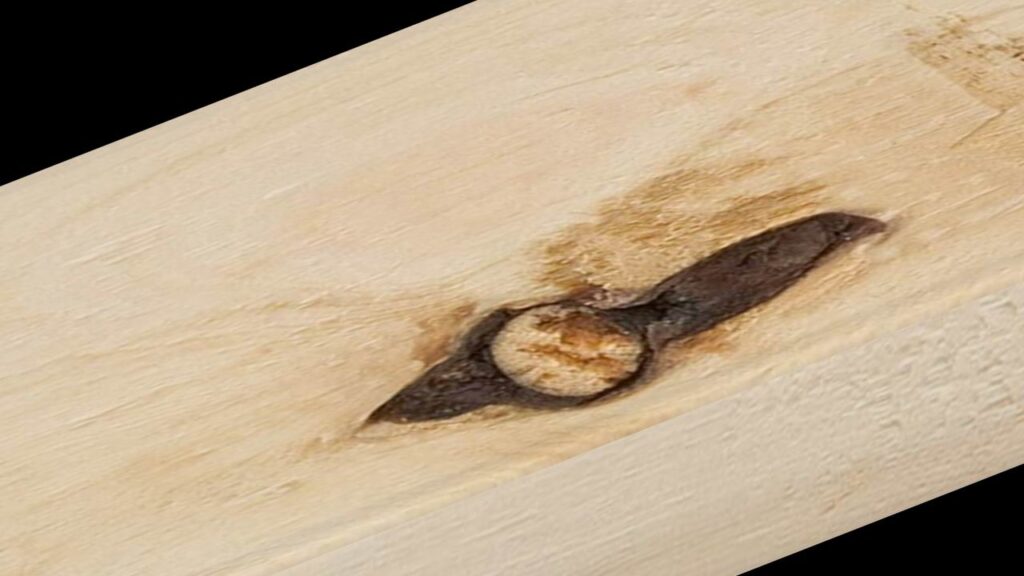
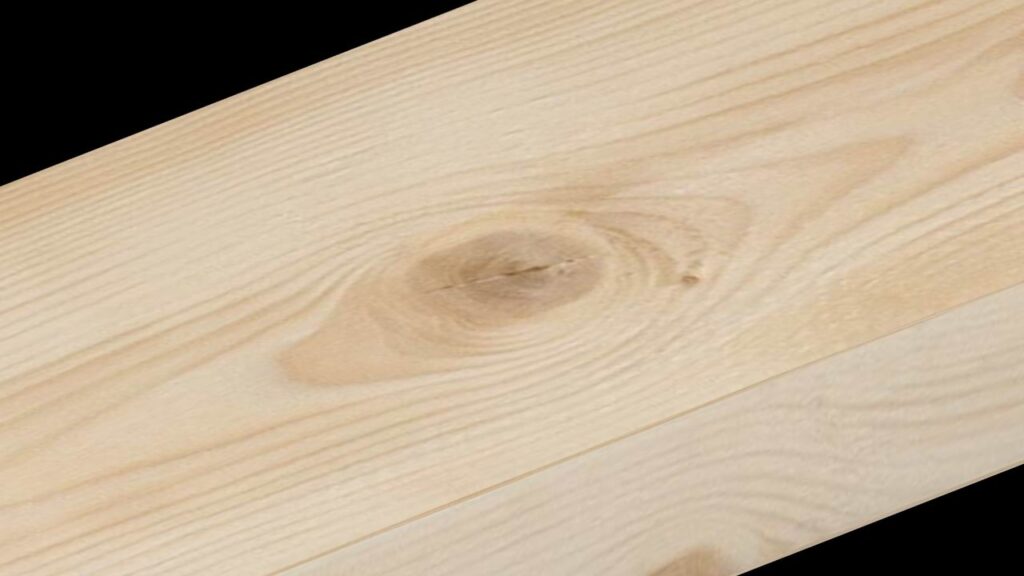
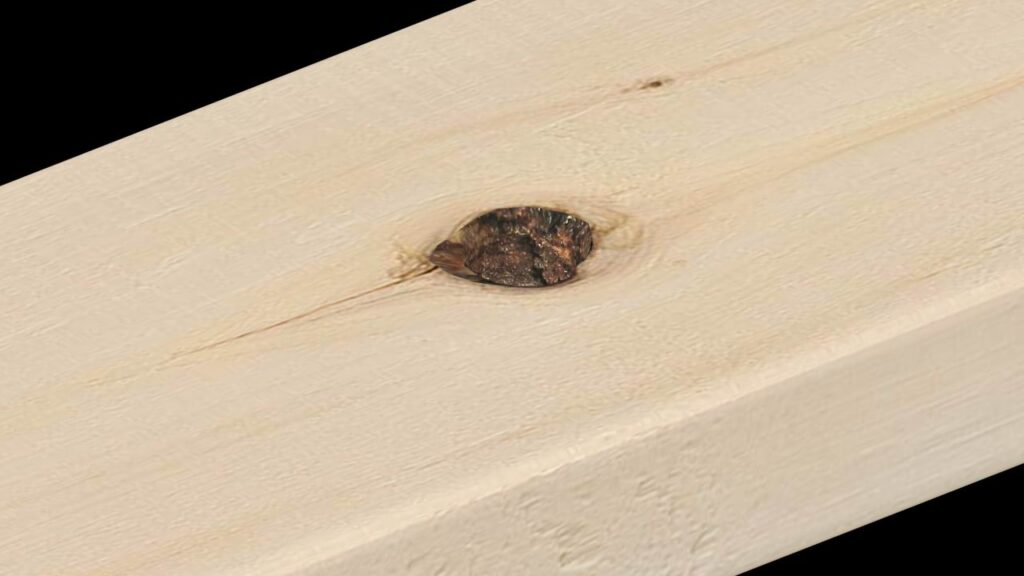
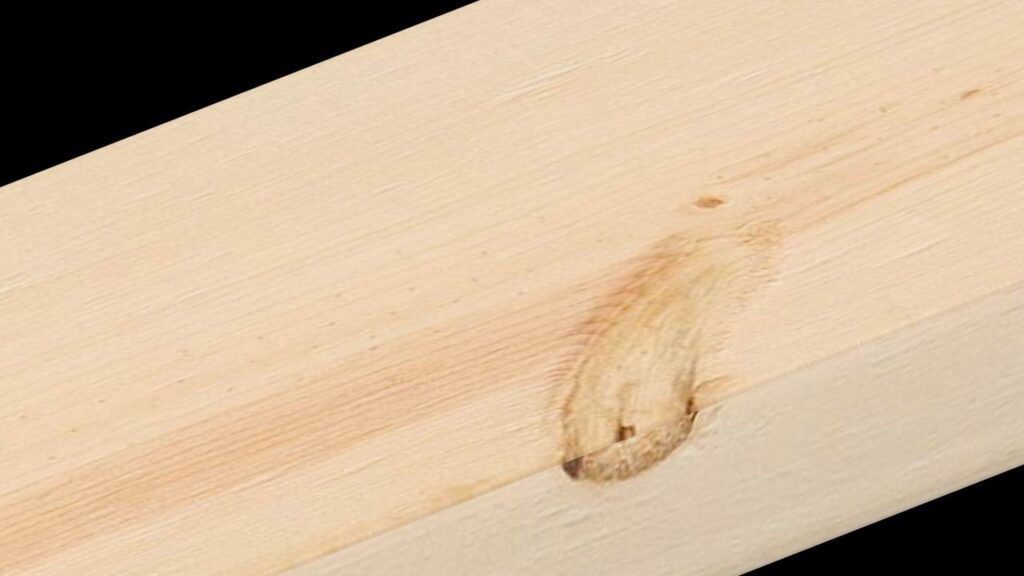
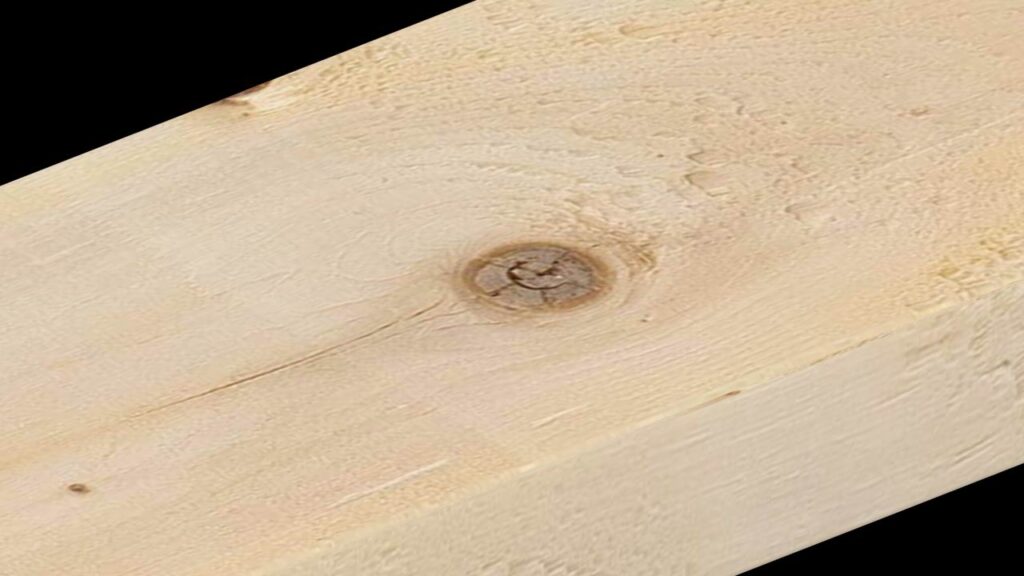
A knot containing seasoning checks, or cracks, caused by shrinkage stresses as the branch wood dries. The checks commonly radiate from the branch pith toward the knot perimeter and may remain within the knot or extend into adjacent wood. Checking describes a separation of fibres and does not, by itself, indicate decay or establish whether the knot is tight or loose.
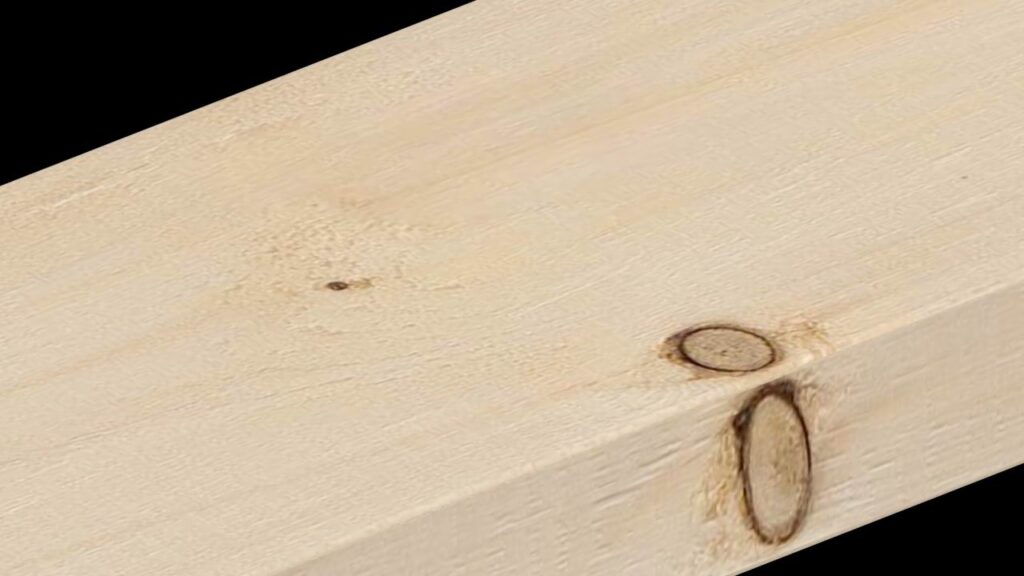
Encased Knot
A knot whose growth rings are not intergrown with those of the surrounding stem wood, commonly separated from it by bark, pitch, or both. It develops when the tree grows around a dead branch. The boundary may appear as a dark ring or seam. An encased knot may remain mechanically secure or become loose; lack of intergrowth alone does not establish whether it will fall out.
Intergrown Knot
A knot in which the branch growth rings are partly or completely continuous with the growth rings of the surrounding stem wood. This connection forms while the branch is alive and becomes incorporated into the growing trunk. Grain in the adjacent wood bends around the branch. Intergrowth helps retain the knot, but its effect on lumber strength still depends on size, position, and the associated grain deviation.
Knot Hole
An opening left when all or part of a knot falls out or is removed from a piece of lumber. Its shape reflects the branch orientation and the plane of the saw cut, so it may be round, oval, or elongated. The opening may pass through the piece or terminate within it. It interrupts the wood section and can affect appearance, surface continuity, and suitability for the intended use.
Loose Knot
A knot insufficiently secured by growth, shape, or position to be expected to remain in the piece. It commonly originates from a dead branch that became encased as the stem continued to grow. Shrinkage or handling can loosen the boundary further, allowing the knot to move or fall out and leave a knot hole. A loose knot may contain sound wood; looseness does not necessarily indicate decay.
Slough Knot Hole
A corner knot hole that opens from a wide face into the adjoining narrow face or edge of a piece. It forms when a knot intersecting that corner is lost, leaving an opening across two adjacent surfaces. Its distinguishing feature is the connected opening at the corner. The missing wood affects both the face and edge profile and may interfere with joints or an exposed finished edge.
Spike Knot
An elongated knot exposed when a branch is cut approximately along, or obliquely to, its longitudinal axis. It often has a narrow, tapering outline and is commonly encountered on vertical grain surfaces, although its defining feature is the cutting direction relative to the branch axis. The term describes knot shape, independently of whether the knot is sound, unsound, tight, loose, encased, or intergrown.
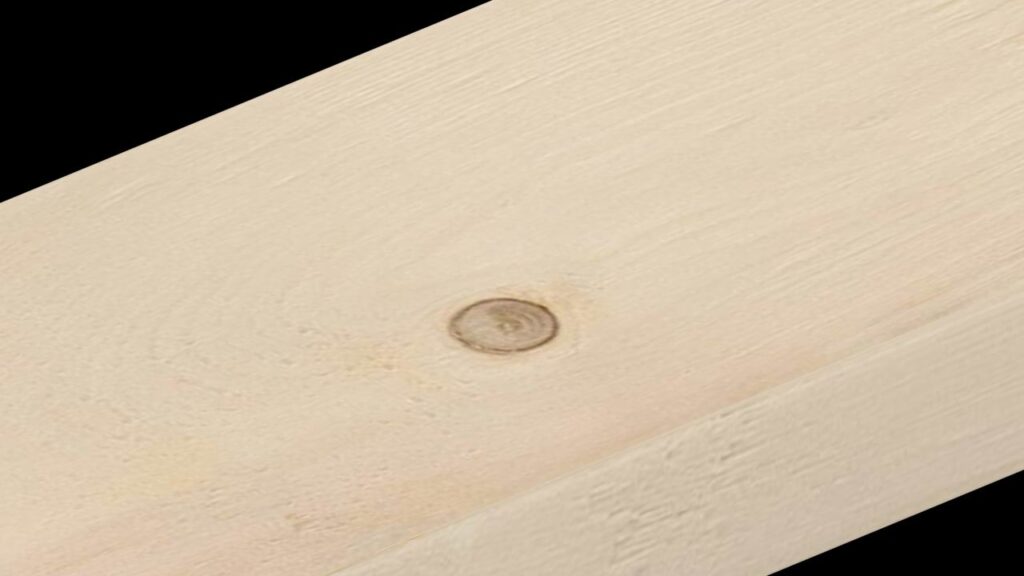
Tight Knot
A knot held securely enough by growth, shape, or position to retain its place in the piece. It may be intergrown with the surrounding wood or mechanically retained despite being encased. Tightness therefore describes retention rather than whether the branch was alive or dead when incorporated into the stem. A tight knot can still contain checks or decay, which must be assessed separately.
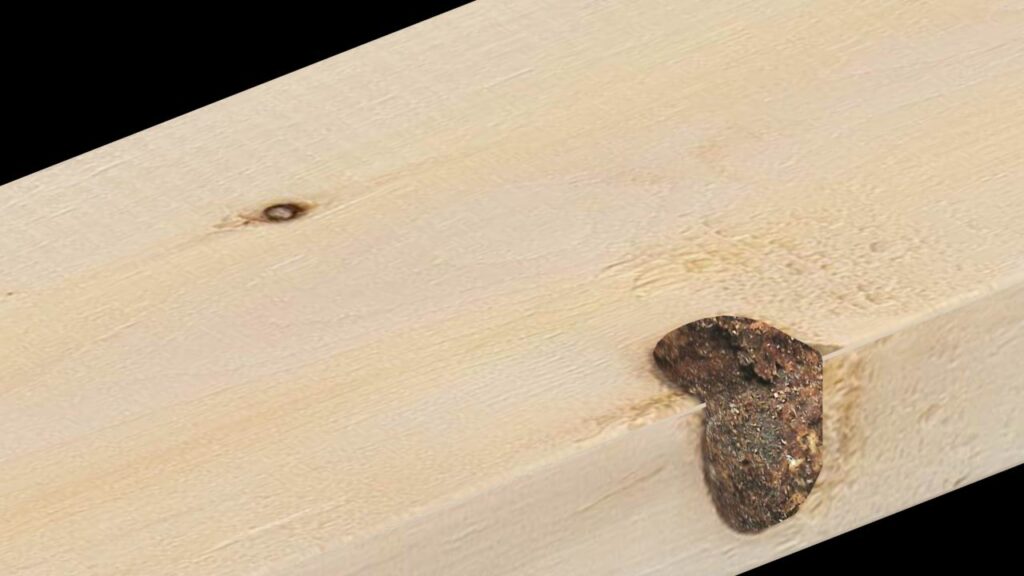
Unsound Knot
A knot containing wood decay caused by wood destroying fungi. Depending on the stage of decay, the affected wood may show reduced hardness, loss of cohesion, or a crumbly or fibrous texture. Colour alone does not establish unsoundness; a dark knot can be sound. Decay can weaken the knot and may facilitate breakage or loss of material. Any decay extending into surrounding wood requires separate assessment.
Technical references
National Lumber Grades Authority. Standard Grading Rules for Canadian Lumber, 2025. Paragraphs 716e and 718: slough knot holes, knot shapes, intergrowth, retention, and condition. View source
USDA Forest Service, Forest Products Laboratory. Wood Handbook, FPL-GTR-282. Chapters 5 and 7: effects of knots and grain deviation on wood properties and lumber grading. View source